
Texas Release Records Explained
“Released” describes an exit from a particular custodian. It does not always mean the person went home or finished a sentence. A county jail may release someone on bond, after time served, after a dismissal, or under a court order. The jail may also transfer the person to TDCJ, another county, federal custody, immigration custody, or a treatment placement. TDCJ can release a prisoner to parole or mandatory supervision while the sentence continues outside prison. A flat discharge is different because it marks the legal end of the sentence obligation.
That layered system explains why Texas released inmates do not sit in one statewide archive. County sheriffs maintain booking and exit records for local custody. TDCJ maintains state-prison incarceration and release records. The Texas Board of Pardons and Paroles decides parole and discretionary mandatory supervision, while the TDCJ Parole Division supervises those releases. Courts keep the order, judgment, bond, or dismissal that supplied legal authority. The physical exit and the legal reason may therefore appear in separate records.
The official TDCJ home page shows the agency identity used for state custody and release records.

This source belongs to the state-prison layer, not to a county booking or federal case.
Texas Inmate Release Types
The legal mode controls what should be checked next. Parole is a discretionary release granted through the Board, followed by supervision through the Parole Division. Mandatory supervision also continues the sentence outside prison. For many eligible offenses committed on or after September 1, 1996, discretionary mandatory supervision requires Board approval. A discharge reaches the sentence endpoint. County bond, time-served, dismissal, and probation events arise from the local case and jail record instead.
| Release or exit | What it means | Next record source |
|---|---|---|
| Bond or dismissal | County custody ends under local case authority | Sheriff release record and court clerk |
| Time served | A county or state term reaches its required endpoint | Holding agency and sentencing court |
| Parole | The rest of a state sentence is served under supervision | BPP status, Parole Division, IVSS, and TDCJ records |
| Mandatory supervision | Statutory supervised release applies after required calculations and any needed vote | TDCJ, BPP, Parole Division, and IVSS |
| Flat discharge | The state sentence obligation has ended | TDCJ discharge documentation |
| Transfer | One custodian records an exit while another takes custody | The sending record plus the receiving agency |
Key distinction: leaving a jail or prison building is not proof that all custody or supervision ended.
Texas Release Record Fields
A useful request asks for facts, not a broad file. County terminology varies, but a booking or custody-history record may connect the person, booking number, facility, admission date, out date, exit reason, and transfer destination. A court order can explain the authority for release. TDCJ records can identify admission and release dates, the legal type of exit, incarceration history, and available certificate or discharge material. These fields should be read together because an out date alone does not say whether the person entered another system.
| Field | What it establishes |
|---|---|
| Name and agency number | Links the record to a person and booking, SID, TDCJ, or federal identifier |
| Admission or booking date | Marks the start of the custody period being checked |
| Out or actual release date | Marks departure from the named custodian |
| Release type or reason | Distinguishes bond, parole, discharge, transfer, and other legal modes |
| Releasing facility | Identifies the office most likely to hold the custody record |
| Destination or receiving authority | Shows whether the exit may have been a transfer |
| Supervision status | Shows whether parole, mandatory supervision, or local community supervision continues |
| Certificate or signed order | Documents authority for release or proof of final discharge, depending on the instrument |
Does an out date prove community release? No. It proves an exit from the named booking. Check any destination, hold, or receiving authority before describing the event.
Request Texas Release Records
The Texas Public Information Act applies to existing information held by governmental bodies, subject to exceptions and other confidentiality laws. The request goes to the body that holds the record. It need not answer questions, conduct legal research, or create a report. Court case records use court rules and clerk procedures rather than the Act. Fees, estimates, redactions, and delivery time depend on scope and the custodian. “Promptly” means a reasonable production time, not automatic delivery within ten business days.
- Identify the holding agency and the exact custody period. Use the county for a jail booking, TDCJ for a state sentence, or the federal agency for federal custody.
- Give the full name, known booking or agency number, date of birth when needed, and a narrow date range. Avoid unrelated personal data.
- Name existing records. Ask for the booking sheet, custody history, out date, release type, transfer destination, or release and discharge certificate that fits the question.
- For TDCJ, send the request through its Public Information Office. Ask for actual dates and legal mode, not merely a projected date.
- For a county matter, use the sheriff or jail records unit. The Texas County Directory routes to the right local source.
- For the legal basis, request the signed order, judgment, bond, or dismissal from the clerk that owns the trial-court file.
TDCJ public-information instructions list an online form, email to PIA@tdcj.texas.gov, and mail or hand-delivery routes. TDCJ identifies PO Box 4017, Huntsville, TX 77342 for mail and 2 Financial Plaza, Suite 600, Huntsville, TX 77340 for hand delivery. A narrow request helps the office locate the right incarceration period and release instrument.
Note: A withholding request may trigger Attorney General review, while expunction, nondisclosure, privacy, juvenile, medical, or security rules may limit production.
Texas Released Record Limits
Government Code Chapter 552 supplies the statewide public-information framework for agency records. Court case files are different. The local clerk is normally the custodian, and access follows common law, statutes, and court rules. Release itself does not seal a record. Expunction under Code of Criminal Procedure Chapter 55A and nondisclosure under Government Code Chapter 411 are separate remedies with case-specific standards and effects.
Retention is also source-specific. The research found no single statewide promise that every county will keep a released booking visible online for a fixed period. Likewise, TDCJ does not publish a retained public profile for discharged people in its current-inmate search. An official record can still exist after a portal stops displaying a name. Ask the custodian rather than reading portal absence as a legal conclusion.
- Expunction
- A court-ordered process that can require covered records to be removed or destroyed when legal standards are met.
- Nondisclosure
- A separate Texas order that limits public access to qualifying criminal-history information.
- Discharge
- The verified end of the sentence obligation, not merely departure from a facility.
- Detainer
- A request or hold that can send a person to another custodian after an exit.
Texas Criminal Record Corrections
Texas treats a source government record, a sealing remedy, and commercial republication as distinct legal subjects. Business & Commerce Code Chapter 109 creates correction and removal duties for defined criminal-record publishers in specified circumstances. It also addresses charging a fee to remove covered information. The law does not promise that every official record or news item will vanish after release.
The sound sequence is to check the official court or agency source, obtain any signed expunction or nondisclosure order, and identify which record the order reaches. A portal that lawfully removes a record should not be treated as evidence that the underlying event never occurred. At the same time, an old copied entry should not override a current government record. This is one reason a precise release request is more reliable than a loose name search.
Search Texas Released Inmates
Start with the custody layer, then use two records when the result matters: one for physical exit and one for legal status. A county case begins with the sheriff and trial-court clerk. A state sentence begins with a current-custody check, then moves to TDCJ historical information or public records for a past event. Active parole or mandatory supervision adds BPP, Parole Division, or IVSS. Federal imprisonment uses BOP. Immigration detention uses ICE. Each source answers a smaller question than “Where is this person now?”
- Confirm the full name and a reliable identifier. A booking number, TDCJ number, SID, or federal number is safer than a common name.
- Check the last known custodian. Read an exact out date, transfer label, current unit, or release field in context.
- Follow the destination. An exit to another county, TDCJ, BOP, or ICE is a custody change.
- Check the legal record. Match the jail exit to the signed court order or the state release authority.
- Verify ongoing supervision through the responsible parole office, IVSS, or the sentencing court and local CSCD.
- Request the historical record when a live portal does not retain the event.
No-result rule: A missing name on a live roster or TDCJ search does not prove release, discharge, or freedom from another hold.
TDCJ Current Custody Search
The Texas Department of Criminal Justice online search includes only people currently incarcerated in a TDCJ facility. It accepts a seven-digit TDCJ number, a SID number, or a last name with at least the first initial. Gender and race can narrow a name search. A current detail can show the unit, offenses, maximum sentence date, projected release date, parole eligibility date, and later scheduled release fields when processing reaches that stage.
Those fields forecast or schedule an event. They are not an archived actual-release entry. TDCJ says the data is updated on working days and is at least 24 hours old. A person who has been paroled, released to mandatory supervision, or discharged drops from this public current-inmate search. For a past event, use TDCJ's email or telephone information channel for incarceration history and actual release facts, or request existing release documents through the Public Information Office.
| Search or detail field | How to read it |
|---|---|
| TDCJ number | Seven-digit state corrections identifier |
| SID number | State identification number used as another direct search route |
| Name, gender, race | Name search and narrowing fields that still require identity comparison |
| Projected Release Date | Calculated date if no earlier parole event occurs under the applicable branch |
| Scheduled Release Date | Later processing field that can still change without notice |
| Scheduled Release Location | Planned processing location, not proof the exit happened |
The TDCJ agency page provides a second source view used to identify the office behind these records.
This repeated agency image appears here because the section separates current online custody data from TDCJ historical release records. For deeper field and request detail, use the TDCJ Offender Search page.
Texas County Release Search
Texas has 254 counties, but no merged statewide county-jail release feed. Some sheriffs display an out date or recent-release view. Others publish only current custody and require telephone verification or a records request for a past booking. Large counties may operate several buildings or use contract beds. A rural county may have a simpler roster but a different retention window. The same missing name can therefore have a different cause from county to county.
Use the county where the person was booked, not merely the county of conviction or residence. Ask whether the exit was bond, sentence completion, dismissal, transfer, or another legal event. Then match the jail record to the local court file. If the sheriff records a transfer to TDCJ, the county out date proves only that the county stopped holding the person.
Note: County release feeds differ in fields and retention, so compare the sheriff record with the court order and any receiving-custody entry.
Texas Court Release Records
Texas does not offer one public trial-court person search. The Office of Court Administration does not keep individual trial-court case records. District and county cases route to the proper clerk, while justice and municipal matters route to the court. A signed bond, dismissal, judgment, or release order can explain why an exit was authorized. It cannot prove the exact time a jail completed processing or rule out a hold from another authority.
The re:SearchTX portal is one statewide entry point for electronic court material.
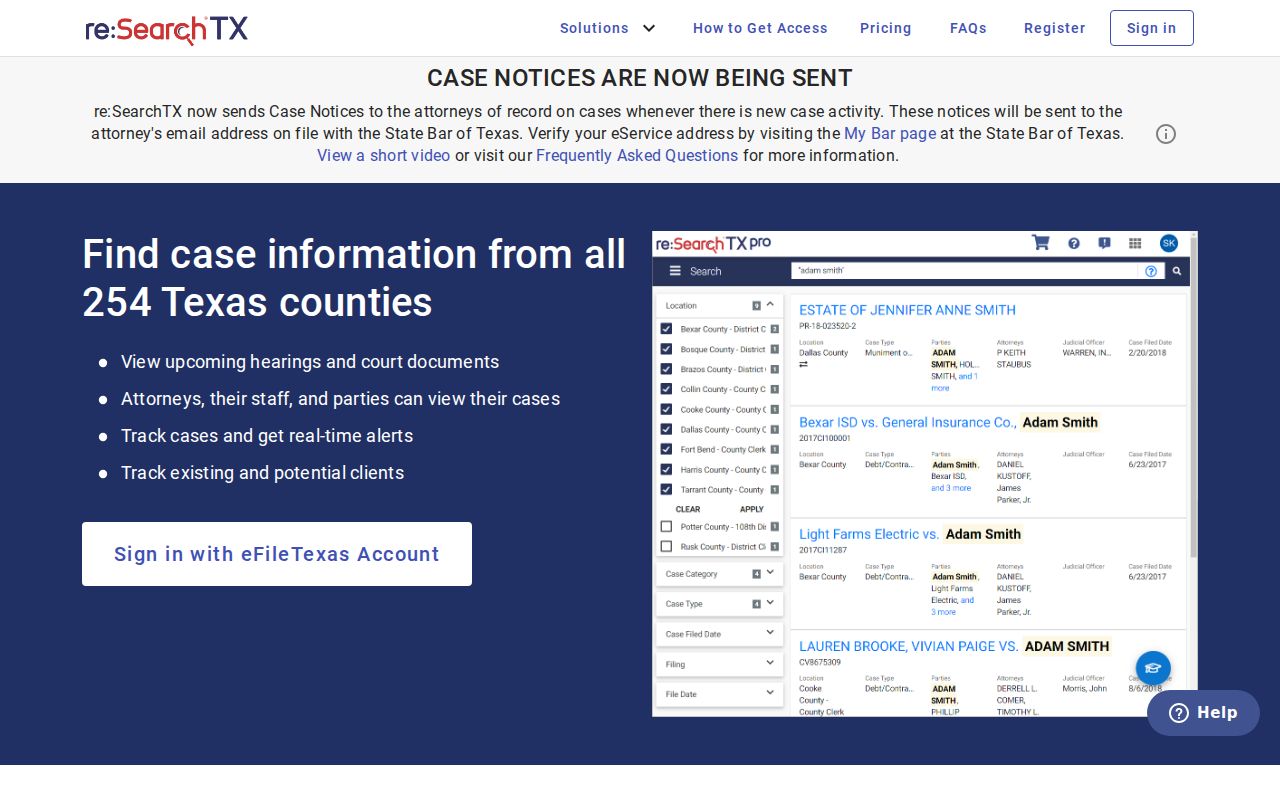
Its e-filing-derived view is not a universal criminal or jail-release database, and local clerk access rules still control many records.
Texas Prison Release Day
TDCJ publishes concrete state-prison release logistics. Releases normally occur from 8:00 a.m. to 5:00 p.m., Monday through Friday except holidays, yet a scheduled event can change. Certain male prisoners, including people with specified detainers, classifications, or Board-imposed intensive supervision or electronic monitoring conditions, process through the Huntsville Unit. Other locations depend on assignment and processing. State-jail prisoners leave from the assigned unit or receive transport to the county of residence. A planned pickup should be confirmed with the unit first.
TDCJ provides civilian clothing, the remaining trust-account balance, and a bus voucher when bus travel is used. A parole or mandatory-supervision release receives a $50 gate check and another $50 after reporting to the parole officer. A Correctional Institutions Division prisoner who flat-discharges receives $100. State-jail prisoners receive no release money under Government Code §501.015(b). These are TDCJ rules and do not establish what a county jail provides.
Texas Release Certificate Proof
A release certificate may authorize parole or mandatory-supervision departure while the sentence continues. Proof that supervision later ended is a separate discharge record. The distinction prevents a planned or supervised exit from being mislabeled as final sentence completion.
Ask for the document that matches the point being proved: the custody record for physical exit, the certificate for supervised-release authority, or TDCJ discharge documentation for the final endpoint. One instrument should not be treated as proof of all three events.
Texas Release Trends
TDCJ reported 50,612 total releases in fiscal year 2025. That total included 37,587 prison releases, 8,212 state-jail releases, and 4,813 releases from the Substance Abuse Felony Punishment program. Prison releases included 18,625 paroles, 11,967 discretionary mandatory-supervision events, 99 mandatory-supervision events, 6,774 discharges, and 122 releases to community supervision.
The annual total rose by 3,964 from 46,648 in fiscal year 2024, an increase of about 8.5 percent. Combined parole, discretionary mandatory supervision, and mandatory supervision rose from 27,464 to 30,691. Yet the parole-type supervised population was 97,672 on August 31, 2025, down slightly from 98,000 one year earlier. Annual exits and the number supervised on one date measure different things.
The TDCJ fiscal year 2025 report supplies the dated release and supervision figures.
These counts cover TDCJ releases, not every county, federal, or immigration exit in Texas.
Texas Parole Release Status
The Texas Board of Pardons and Paroles makes parole and discretionary mandatory-supervision decisions. It is separate from the TDCJ Parole Division, which supervises people after release. Ordinary parole and mandatory-release reviews do not use a formal public hearing or person-by-person calendar. Panel members vote case files individually. A favorable vote can still depend on a future date, a required institutional program, record audit, an approved plan, or other release processing.
The official panel-review explanation shows why an agency meeting calendar should not be read as an inmate hearing calendar.
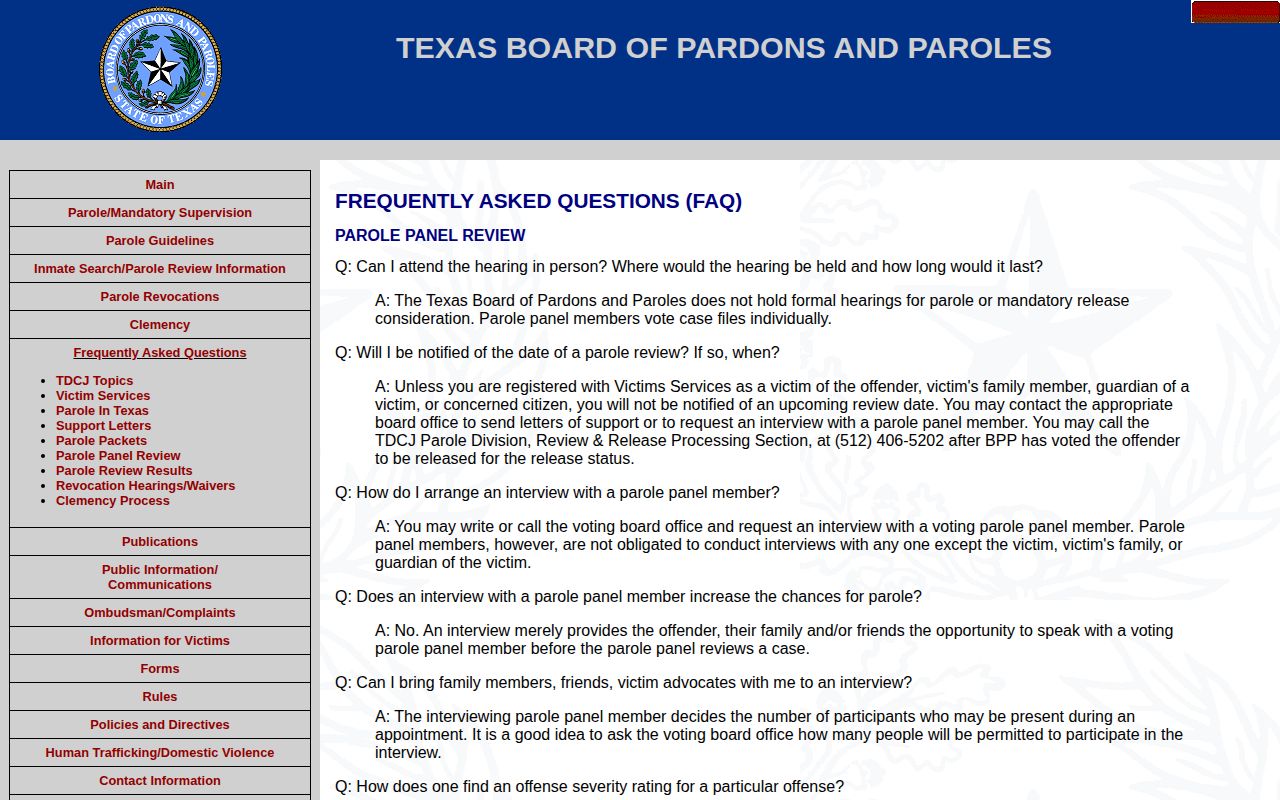
For a named person, use the Board status route and its 844-512-0461 status line rather than looking for a public hearing date.
Texas Parole Meeting Records
The Board’s old meeting schedule page is historical agency-business material.
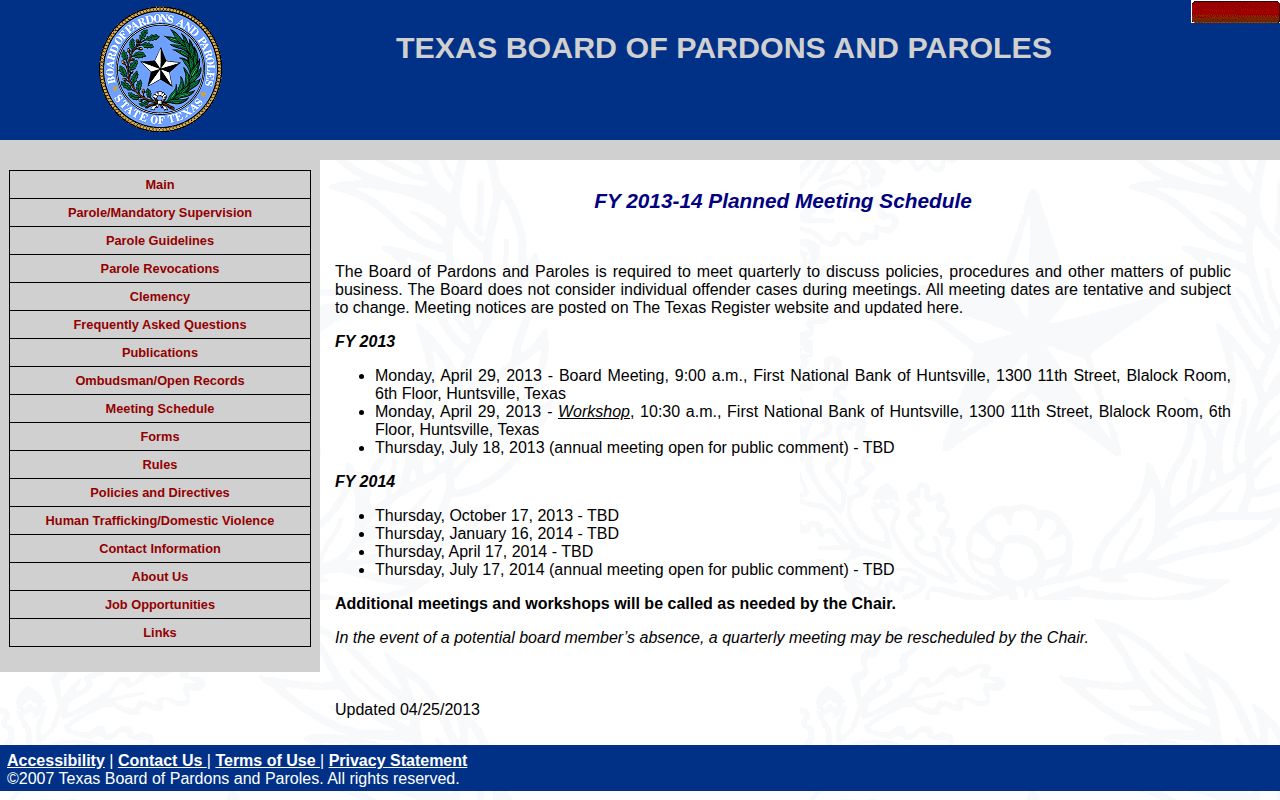
It covers fiscal years 2013 and 2014 and should not be used to infer a current person’s review or release status.
The Board also publishes meeting and workshop minutes for agency business.

Those minutes do not replace the status route, TDCJ release processing, or a person-specific record request.
Texas and Federal Release Checks
Texas now uses two official notification paths. IVSS covers TDCJ custody and people on parole or mandatory supervision. IVSS-Counties replaced county VINE/VINELink on September 1, 2025, but not every county participates. It can provide booking, release, court-setting, death, escape, or transfer notices from participating local systems. Notification data should still be matched to the sheriff record, especially when a transfer or coverage gap is possible.
Federal prison cases use the BOP Inmate Locator, which generally covers federal inmates released after 1982 and updates daily. It supports number and name searches. A past release date and a `RELEASED` location mean the person is no longer in BOP custody. They do not rule out supervision or later custody elsewhere. A future date is projected, while `UNKNOWN` means the confinement term has not been determined.
The BOP Inmate Locator displays the federal number and name search routes.
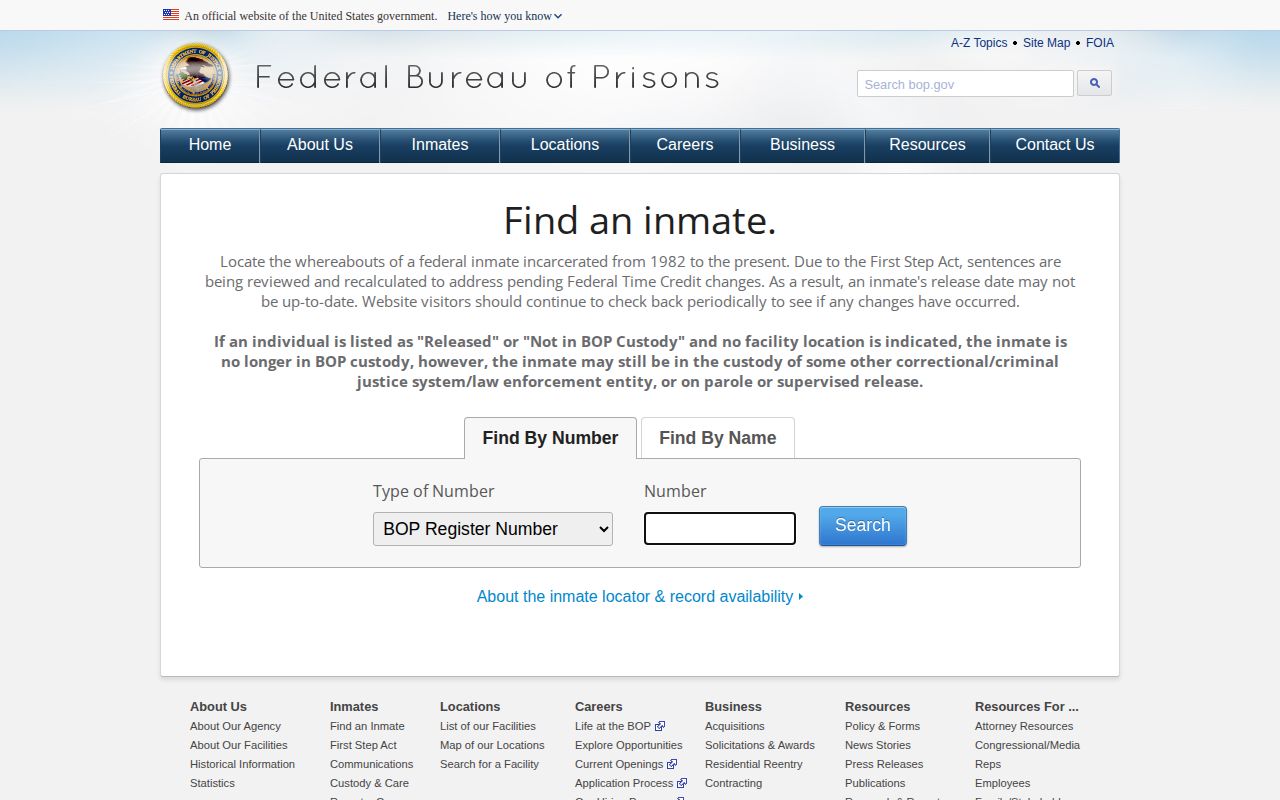
This federal result path is separate from TDCJ, county jails, and Texas parole records.
Texas Immigration Release Checks
ICE’s Online Detainee Locator accepts a nine-digit A-number with country of birth. A second route requires an exact biographical match using first name, last name, country of birth, and date of birth. It does not search people under 18.
The locator covers current detainees and people released from ICE custody during the prior 60 days. A county exit to ICE is a transfer, not a community release. After that window, use authorized ICE case or records channels and distinguish release, transfer, removal, and departure from ICE custody.
Texas Release Sources Compared
The strongest match joins the system that recorded physical custody with the source that states legal authority. Do not force a county, state, federal, or immigration event into the wrong portal.
| System | What the live source shows | Past release route |
|---|---|---|
| County jail | Current roster and, in some counties, out dates or recent exits | Sheriff records plus local court clerk |
| TDCJ | Current inmates and projected or scheduled fields | TDCJ information service, PIA request, Parole Division, and court record |
| IVSS | TDCJ status and notification data, including parole or mandatory supervision | Reconcile the notice with agency records |
| BOP | Federal location and past or projected release date | BOP locator, judgment, and federal records request |
| ICE | Current custody and exits within the prior 60 days | ICE locator during the window, then authorized records routes |
| Texas court | Legal order or case disposition where accessible | Correct trial-court clerk |
Note: Exact names, dates of birth, and agency numbers reduce false matches, but only the record owner can certify its own custody event.