
TDCJ Offender Search Scope
The Texas Department of Criminal Justice, or TDCJ, runs the state prison system and the public inmate-information routes tied to that system. The online locator is a current-inmate tool. TDCJ states that it includes only people who are incarcerated in a TDCJ facility. Its data is updated on working days and is at least 24 hours old. County jail bookings, federal prisoners, immigration detention, and people on county community supervision belong to other systems.
This limit changes how a search result should be read. A matching detail establishes that the person remains in TDCJ custody as of the data shown. No match does not prove release. The name may be incomplete, an identifier may be wrong, the data may lag, or the person may never have entered TDCJ. It can also mean the person has left state prison. Only a later agency record can settle which reason applies.
The official TDCJ home page shown in this capture confirms the agency name and provides the starting point for its correctional services.

The agency identity matters because a county sheriff, the Board of Pardons and Paroles, and TDCJ each hold different parts of a release history.
Use the TDCJ Offender Search
The TDCJ Online Inmate Search accepts a seven-digit TDCJ number, a state identification number known as a SID, or a last name with at least the first initial. Gender and race can narrow a name query. An identifier search is usually stronger than a name-only match, but the detail should still be checked against age, conviction county, and offenses.
- Choose the TDCJ number or SID route when the number is known. Otherwise enter the surname and first initial.
- Use the optional fields only to reduce a long result set. Do not reject a plausible record from one minor spelling difference.
- Open the matching current-inmate detail and compare the identity fields, conviction county, offenses, and unit location.
- Copy each date label exactly. A projected date, parole eligibility date, and scheduled date describe different stages.
- If the person does not appear, move to the historical information routes. Do not relabel a blank result as released or discharged.
The current detail can show a Maximum Sentence Date, Projected Release Date, and Parole Eligibility Date. Once release has been authorized and processed, a special-information area may show a Scheduled Release Date, Scheduled Release Type, and Scheduled Release Location. TDCJ warns that even a scheduled event can change without notice.
Note: Current unit location proves custody at the reported update, not that a physical release has occurred or will occur on schedule.
Texas Prison Release Fields
The live TDCJ detail is useful because its labels show how far a case has moved toward release. They are not interchangeable. A parole eligibility date marks the first possible review point under the governing law. A projected release date is calculated by Classification and Records. A scheduled release appears later, after authority and processing have reached the stage described by TDCJ. None is a public historical actual-release field.
| Live field | What it establishes |
|---|---|
| TDCJ number | The seven-digit agency identifier used to match the state-prison record. |
| Current facility | The TDCJ unit holding the person at the working-day update. |
| Maximum Sentence Date | The sentence endpoint calculated from the record, distinct from an earlier supervised release. |
| Projected Release Date | The calculated prison-exit date if parole does not occur sooner, under the branch that applies. |
| Parole Eligibility Date | The point at which review can begin, not approval and not a release promise. |
| Scheduled Release Date | A later processed plan that remains subject to change before physical departure. |
| Scheduled Release Location | The planned processing site, which may differ from the current unit. |
A researcher should preserve the label with the value. Calling every date a release date can turn an eligibility milestone into a false claim that a person left prison. For a past event, ask TDCJ for the actual date and legal mode.
Verify a Past TDCJ Release
TDCJ provides email and telephone channels as alternatives to its live search. For email, send the full name and seven-digit TDCJ number to the TDCJ inmate-information service. If the number is unknown, TDCJ asks for an exact date of birth. An approximate age and county of conviction can help when the date of birth is also unknown. Ask for incarceration history, actual release or discharge date, and the legal form of exit.
The telephone channel uses the same identifying facts. Ask whether the recorded event was parole, mandatory supervision, flat discharge, or transfer. This is more precise than asking whether the person simply got out. TDCJ says the general information service is free, but it does not provide photographs or Social Security numbers through that route.
If documentary proof is needed, request an existing record through the TDCJ Public Information Office. A narrow request may identify admission and release dates, release type, release or discharge certificate, destination authority, TDCJ or SID number, and incarceration period. Texas Government Code Chapter 552 allows exceptions and other confidentiality laws, so an agency may redact or withhold protected parts.
The sequence matters when records conflict. First save the live TDCJ labels and their update context while the person remains listed. Next, use the information service to resolve identity and ask for the recorded exit. Then obtain the underlying document if the distinction between release and discharge must be shown. A court judgment can confirm the sentence imposed, while the TDCJ custody record shows how the agency carried it out. One source should not be made to answer a question owned by the other.
A supervision check may be needed after the prison exit. The TDCJ Parole Division handles parole and mandatory supervision, while a county Community Supervision and Corrections Department handles probation, which Texas generally calls community supervision. The statewide TDCJ current-inmate search does not serve as a probation locator. For a parole or mandatory-supervision case, the strongest end-of-supervision proof is TDCJ discharge documentation tied to the person and sentence.
Note: Ask for an existing named record and date range; the Public Information Act does not require an agency to answer questions or create a report.
TDCJ Release and Discharge Types
Leaving a TDCJ unit does not always end the sentence. Parole is a discretionary release to serve the remaining term under TDCJ Parole Division supervision. Mandatory supervision also continues the sentence outside prison when the statutory rules are met. For eligible later cases, discretionary mandatory supervision requires Board approval. Flat discharge means the sentence reached its legal endpoint.
- Parole
- Conditional release approved by the Texas Board of Pardons and Paroles, followed by Parole Division supervision.
- Mandatory supervision
- A supervised release path based on calendar time, eligible good-conduct time, offense date, and statutory eligibility.
- Discretionary mandatory supervision
- The post-cutoff form that also requires a favorable Board decision before release.
- Flat discharge
- The verified end of the sentence obligation, rather than a move from prison to supervision.
- Detainer
- A request or legal hold that can send the person to another authority after TDCJ custody ends.
A transfer to ICE, federal custody, another state, or a county is still a departure from TDCJ physical custody. It is not proof that the person entered the community. Follow the recorded destination until the receiving system confirms its own outcome.
Eligibility should also be kept apart from release. The Board can consider an eligible case and deny it. A favorable vote can require a program or other condition before a release certificate issues. Classification and Records then audits the file and calculates or confirms the schedule. An approved plan, scheduled location, and final gate processing may follow. The record is most accurate when each of these steps retains its own label instead of being summarized as one release decision.
The official parole-panel review explanation pictured here shows why release authority cannot be reduced to a public hearing date.
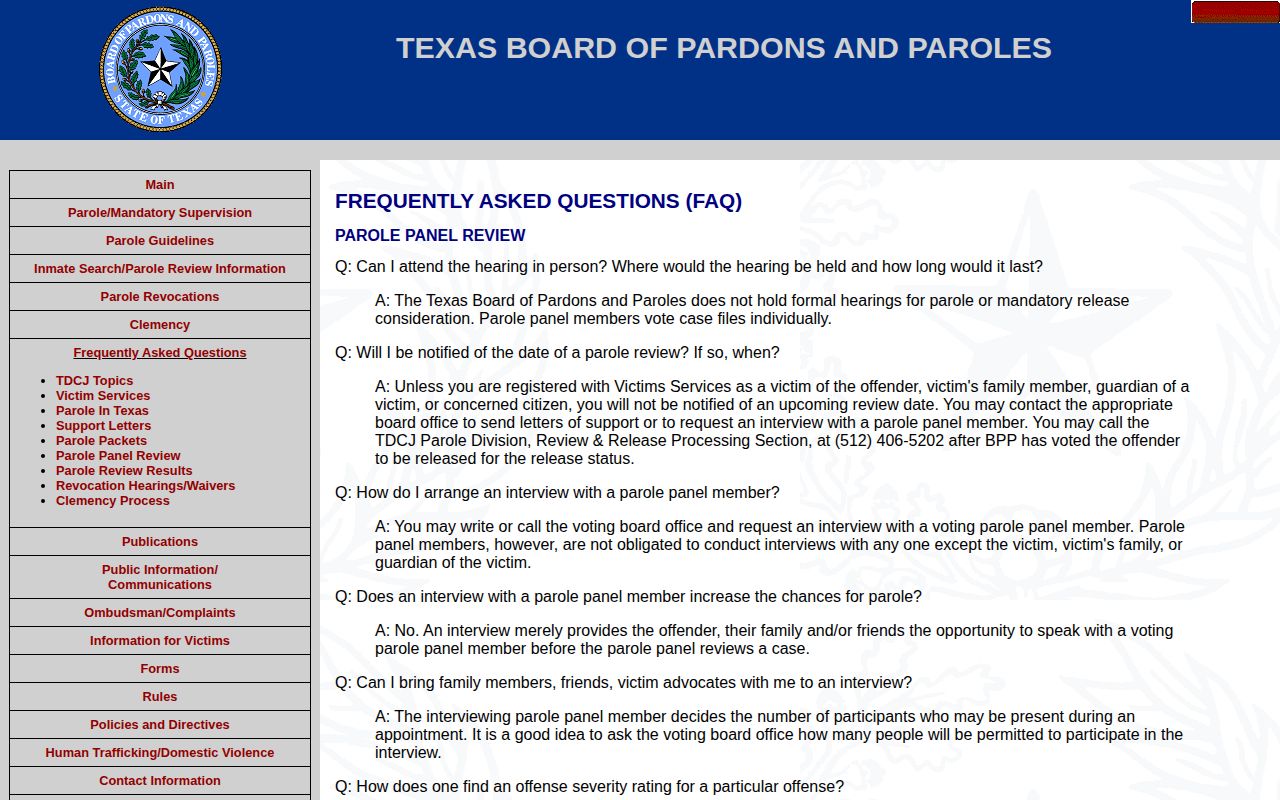
Ordinary parole and mandatory-supervision cases are decided through individual file votes, so a favorable stage still must be followed through release processing.
Texas TDCJ Release-Day Logistics
TDCJ publishes details that help distinguish a planned release from the event itself. Releases occur from 8:00 a.m. through 5:00 p.m., Monday through Friday except holidays. The agency still warns that a scheduled release may change. A family planning a pickup should call the unit before traveling.
Some male prisoners are processed at the Huntsville Unit because of a detainer, sex-offender classification, or Board-imposed Super Intensive Supervision Program or electronic-monitoring condition. Other locations depend on unit assignment and release processing. State-jail prisoners leave their assigned unit or receive transportation to their county of residence.
TDCJ provides civilian clothes, the remaining trust-account balance, and a bus voucher when bus travel is used. A parole or mandatory-supervision releasee receives a $50 gate check and another $50 after reporting to the parole officer. A Correctional Institutions Division prisoner who flat-discharges receives $100. State-jail prisoners receive no release money under Texas Government Code section 501.015(b). These TDCJ rules do not describe county-jail property or funds.
Texas TDCJ Release Trends
The TDCJ statistical reports separate annual release events from the number supervised on one date. That distinction prevents a common counting error. One person may produce a release event during a fiscal year while remaining in the supervised population at year end.
TDCJ recorded 50,612 releases in fiscal 2025, compared with 46,648 in fiscal 2024. The rise was 3,964, or about 8.5 percent. Fiscal 2025 included 37,587 prison releases, 8,212 state-jail releases, and 4,813 Substance Abuse Felony Punishment releases. Within the prison count were 18,625 parole releases, 11,967 discretionary mandatory-supervision releases, 99 mandatory-supervision releases, 6,774 discharges, and 122 releases to community supervision.
At August 31, 2025, the parole-type supervised population was 97,672, including 75,454 in active status. The comparable total one year earlier was 98,000. Annual releases rose while the point-in-time supervised count edged down. Both facts can be true because they measure different things.
The Board meeting and workshop archive in this image is an agency-business source, not a list of individual TDCJ release outcomes.

Named-person verification must use the status, agency-information, and records routes instead of reading business minutes as a release calendar.
Texas Release Records by Custodian
A Texas county jail and TDCJ record different events. A sheriff's OUT DATE establishes departure from one county booking. It may lead to TDCJ intake, another county, federal custody, ICE, or the community. The TDCJ search begins only after state custody exists and ends as a public profile when that custody ends. The Texas County Directory routes a county booking to the local source.
| Custody layer | Live route | Past-release proof |
|---|---|---|
| TDCJ state prison | Current-only TDCJ offender search | TDCJ information service or Public Information Act record |
| Texas county jail | County sheriff roster where available | County release, booking, transfer, or disposition record |
| Federal prison | BOP Inmate Locator | BOP locator history or federal record |
| ICE detention | ICE detainee locator within its stated window | Authorized ICE case or records route |
The federal locator captured here illustrates why a TDCJ number cannot be used to resolve a federal prison history.
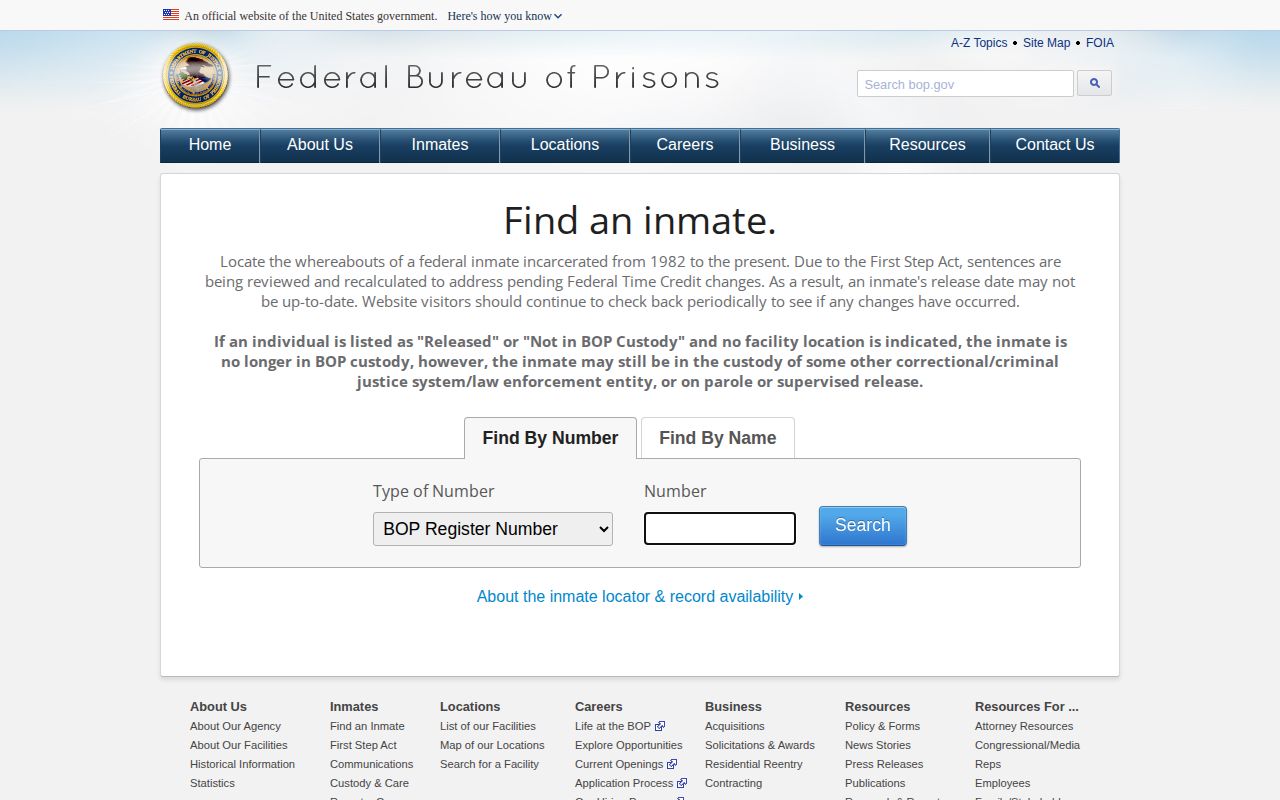
BOP uses federal number and name searches and can retain a released result, while the TDCJ public locator expressly limits results to current inmates.
Note: Always verify the receiving authority after a transfer because departure from one jail or prison is not the same as community release.
TDCJ Release Certificate or Discharge
A release certificate and discharge proof answer different questions. TDCJ release-processing material refers to the certificate reaching Classification and Records before a scheduled date is calculated. That certificate may authorize parole or mandatory-supervision release while the sentence continues outside prison. It does not, by itself, prove that supervision later ended.
Frame the records request around the fact that must be shown. Ask for the physical exit record to prove departure, the release certificate to establish supervised-release authority, or discharge documentation to establish the sentence endpoint. Include the person's identifier and incarceration period. That narrower wording helps the records office locate an existing file and avoids treating one paper as proof of all three stages.
Texas Public Information Act requests may be emailed to PIA@tdcj.texas.gov, mailed to TDCJ Public Information Request, PO Box 4017, Huntsville, TX 77342, hand-delivered to 2 Financial Plaza, Suite 600, Huntsville, TX 77340, or sent through the agency's online form. Production must be prompt, but ten business days is not a universal delivery deadline. Redaction, estimates, confidentiality rules, expunction, and nondisclosure may affect the response.
A useful request states the full name, TDCJ or SID number, conviction county, and the period of confinement. It then names each record sought. Admission and release dates establish the custody span. The release type distinguishes parole, mandatory supervision, flat discharge, and transfer. A destination or receiving-authority entry can show why leaving TDCJ did not mean entry into the community. Asking for releasable classification and release records may supply more context, but the request should stay tied to the event being verified.
The TDCJ Public Information Office also states that inmate telephone and visitation records are not releasable through its Public Information Act process, and subpoenas go to the office of record. Those limits are separate from a request for release or discharge facts. If the agency gives a cost estimate or identifies a statutory exception, respond within the stated process and narrow the request where that will still answer the release question.